Friday, 8 November 2024

LINQ Joins

In LINQ, joins work similarly to SQL joins, allowing you to combine data from two collections based on a related key. Below is an explanation of each type of join: Inner Join, Left Join, Right Join, and Outer Join, along with examples in LINQ.

Let's assume we have the following two classes and two collections, customers and orders:

csharp
public class Customer { public int CustomerId { get; set; } public string Name { get; set; } } public class Order { public int OrderId { get; set; } public int CustomerId { get; set; } public string Product { get; set; } } List<Customer> customers = new List<Customer> { new Customer { CustomerId = 1, Name = "Alice" }, new Customer { CustomerId = 2, Name = "Bob" }, new Customer { CustomerId = 3, Name = "Charlie" } }; List<Order> orders = new List<Order> { new Order { OrderId = 101, CustomerId = 1, Product = "Laptop" }, new Order { OrderId = 102, CustomerId = 1, Product = "Smartphone" }, new Order { OrderId = 103, CustomerId = 2, Product = "Tablet" } };

1. Inner Join

An inner join returns only the matching records from both collections where the CustomerId in customers matches the CustomerId in orders.

LINQ Example:

csharp
var innerJoin = from customer in customers join order in orders on customer.CustomerId equals order.CustomerId select new { CustomerName = customer.Name, Product = order.Product };

Explanation:

  • Only records where CustomerId exists in both customers and orders are returned.

Result:

plaintext
CustomerName: Alice, Product: Laptop CustomerName: Alice, Product: Smartphone CustomerName: Bob, Product: Tablet

2. Left Join

A left join returns all records from the left collection (customers) and the matching records from the right collection (orders). If no match is found, null values are returned for the orders.

LINQ Example:

csharp
var leftJoin = from customer in customers join order in orders on customer.CustomerId equals order.CustomerId into customerOrders from order in customerOrders.DefaultIfEmpty() select new { CustomerName = customer.Name, Product = order?.Product // Null if no matching order };

Explanation:

  • into customerOrders creates a group join, gathering matching orders.
  • DefaultIfEmpty() provides null for orders when there's no match, achieving a left join.

Result:

plaintext
CustomerName: Alice, Product: Laptop CustomerName: Alice, Product: Smartphone CustomerName: Bob, Product: Tablet CustomerName: Charlie, Product: null

3. Right Join

A right join in LINQ (similar to SQL) isn’t directly supported, but we can simulate it by reversing the left join.

LINQ Example:

csharp
var rightJoin = from order in orders join customer in customers on order.CustomerId equals customer.CustomerId into orderCustomers from customer in orderCustomers.DefaultIfEmpty() select new { CustomerName = customer?.Name, // Null if no matching customer Product = order.Product };

Explanation:

  • We start with orders instead of customers, and we join with customers.
  • DefaultIfEmpty() provides null for customers if there is no match, simulating a right join.

Result:

plaintext
CustomerName: Alice, Product: Laptop CustomerName: Alice, Product: Smartphone CustomerName: Bob, Product: Tablet

If there were an order with no matching customer, it would appear with a null for CustomerName.

4. Full Outer Join

A full outer join includes all records from both collections, with null values for non-matching elements. This isn’t directly supported in LINQ, so we simulate it by combining a left join and a right join, excluding duplicates.

LINQ Example:

csharp
var leftJoin = from customer in customers join order in orders on customer.CustomerId equals order.CustomerId into customerOrders from order in customerOrders.DefaultIfEmpty() select new { CustomerName = customer.Name, Product = order?.Product }; var rightJoin = from order in orders join customer in customers on order.CustomerId equals customer.CustomerId into orderCustomers from customer in orderCustomers.DefaultIfEmpty() select new { CustomerName = customer?.Name, Product = order.Product }; // Full outer join: combine left and right joins, remove duplicates var fullOuterJoin = leftJoin.Union(rightJoin);

Explanation:

  • Perform both the left join and right join.
  • Use Union to combine results, removing duplicates to achieve a full outer join.

Result:

plaintext
CustomerName: Alice, Product: Laptop CustomerName: Alice, Product: Smartphone CustomerName: Bob, Product: Tablet CustomerName: Charlie, Product: null

This approach includes all records from both collections, with null for non-matching items.

Share:

Thursday, 7 November 2024

Top 100 Interview Questions c#

 Here is a list of 50 important C# interview questions along with answers that cover fundamental to advanced topics in C#.


1. What is C#?

  • Answer: C# is a modern, object-oriented programming language developed by Microsoft as part of the .NET platform. It is known for being type-safe, flexible, and easy to use, with support for powerful features like LINQ, async programming, and garbage collection.

2. What are the main features of C#?

  • Answer: Key features include object-oriented programming, garbage collection, type-safety, asynchronous programming, language-integrated query (LINQ), exception handling, and a rich set of libraries through .NET.

3. What is the difference between ref and out keywords?

  • Answer: Both pass arguments by reference, but ref requires variables to be initialized before passing, while out does not. out must be assigned a value in the called method.

4. What is static in C#?

  • Answer: static denotes members or methods that belong to the type itself, rather than an instance. Static members are shared across all instances, and they are accessed by the class name rather than by object instances.

5. Explain what is a sealed class in C#.

  • Answer: A sealed class cannot be inherited. This is often used to prevent further specialization of a class, providing better security and performance.

6. What is the difference between const and readonly?

  • Answer: const is a compile-time constant, meaning its value is set at compile time and cannot be changed. readonly is a run-time constant, allowing it to be assigned at declaration or within the constructor.

7. What is delegate in C#?

  • Answer: A delegate is a type-safe pointer to a method. Delegates are used for implementing events and callbacks.

8. What is an event in C#?

  • Answer: An event is a delegate type that enables a class to notify other classes or objects when something of interest occurs, often used for event handling in C#.

9. What is boxing and unboxing in C#?

  • Answer: Boxing is the process of converting a value type to an object or interface type, while unboxing is the reverse. Boxing allocates memory on the heap, making it more costly than working with value types directly.

10. What is an interface?

  • Answer: An interface defines a contract with methods and properties that a class must implement, but it provides no implementation itself.

11. What is the abstract keyword used for?

  • Answer: abstract classes cannot be instantiated and may contain abstract methods (without implementation) that derived classes must implement.

12. Explain polymorphism in C#.

  • Answer: Polymorphism allows methods to do different things based on the object it is acting upon. In C#, polymorphism can be achieved through method overriding (runtime) and overloading (compile-time).

13. What is encapsulation?

  • Answer: Encapsulation is the practice of bundling data (fields) and methods that operate on the data within a class and restricting access to some of the object's components.

14. Explain the concept of inheritance.

  • Answer: Inheritance is an OOP principle where a class can inherit properties and methods from a base class, promoting code reuse and creating a hierarchy.

15. What is the using statement in C#?

  • Answer: The using statement provides a convenient syntax for working with disposable objects, ensuring that they are disposed of once they go out of scope.

16. Explain the purpose of async and await in C#.

  • Answer: async and await are used for asynchronous programming, allowing non-blocking operations to improve application performance and responsiveness.

17. What is the difference between Array and ArrayList?

  • Answer: Array has a fixed size and is type-safe, while ArrayList is dynamically sized and can store any object, but it lacks type safety.

18. What is LINQ in C#?

  • Answer: LINQ (Language Integrated Query) is a set of C# features for querying and manipulating collections in a readable and concise manner.

19. What are generics in C#?

  • Answer: Generics allow you to define classes, methods, and data structures with placeholders for data types, promoting code reusability and type safety.

20. What is a null conditional operator (?.) in C#?

  • Answer: The ?. operator allows you to access properties or call methods on potentially null objects without throwing a NullReferenceException.

Advanced Topics and Concepts


21. What is Dependency Injection (DI) in C#?

  • Answer: DI is a design pattern where dependencies are injected into a class, often using constructor injection, to improve modularity and testability.

22. What is the difference between Task and Thread?

  • Answer: Task represents an asynchronous operation and is more lightweight, whereas Thread is a low-level construct that directly maps to OS threads.

23. What is garbage collection in C#?

  • Answer: Garbage collection is an automated memory management feature that reclaims memory occupied by objects that are no longer in use.

24. Explain what is a Tuple.

  • Answer: A Tuple is a data structure that can hold a fixed number of elements of potentially different types, useful for grouping multiple values.

25. What is covariance and contravariance in C#?

  • Answer: Covariance and contravariance allow for implicit reference conversions in generic interfaces and delegates, facilitating more flexible code.

26. Explain the lock keyword in C#.

  • Answer: The lock keyword is used to ensure that a block of code runs only on one thread at a time, preventing race conditions.

27. What are access modifiers in C#?

  • Answer: Access modifiers (e.g., public, private, protected, internal) control the visibility and accessibility of classes, fields, methods, etc.

28. What is a Constructor and what types are there?

  • Answer: A constructor is a special method invoked when creating an instance of a class. Types include default, parameterized, static, and copy constructors.

29. What is reflection in C#?

  • Answer: Reflection provides a way to inspect and interact with types, methods, properties, etc., at runtime.

30. What is the dynamic type in C#?

  • Answer: dynamic bypasses compile-time type checking, allowing types to be determined at runtime. It is useful for interoperability with COM objects or using dynamic languages.

31. What is Method Overloading?

  • Answer: Method overloading allows creating multiple methods with the same name but different parameters.

32. What is Method Overriding?

  • Answer: Method overriding provides a new implementation of a base class method in a derived class, using the override keyword.

33. Explain abstract class vs. interface.

  • Answer: An abstract class can have implementations, while an interface only defines method signatures. Classes can inherit multiple interfaces but only one abstract class.

34. What is a Indexer in C#?

  • Answer: An indexer allows objects to be indexed like arrays, enabling more readable syntax for accessing data within a class.

35. Explain the this keyword.

  • Answer: this refers to the current instance of the class, often used to access instance members or to disambiguate between fields and parameters.

36. What is a nullable type?

  • Answer: Nullable types allow value types to represent null values, commonly used in database applications.

37. Explain extension methods.

  • Answer: Extension methods add new methods to existing types without modifying the original types, useful for enhancing built-in types or classes.

38. What are anonymous types?

  • Answer: Anonymous types allow you to create objects with properties without explicitly defining a class, often used in LINQ queries.

39. What is the yield keyword?

  • Answer: yield enables a method to return a sequence of values lazily, useful in iterator methods.

40. What is Serialization?

  • Answer: Serialization is the process of converting an object into a format that can be stored or transmitted and then reconstructed later.

Expert Level Questions


41. What is IEnumerable vs. IEnumerator?

  • Answer: IEnumerable is an interface that defines a collection, allowing iteration, while IEnumerator provides the mechanism for iteration.

42. What is IQueryable?

  • Answer: IQueryable allows for querying collections using LINQ-to-SQL or LINQ-to-Entities, deferring execution until the query is iterated.

43. What is IComparable?

  • Answer: IComparable provides a method for comparing objects, allowing for custom sorting in collections.

44. Explain the difference between Equals() and ==.

  • Answer: Equals() checks for value equality, while == checks for reference equality by default unless overridden.

45. What is delegation in C#?

  • Answer: Delegation is the ability of an object to delegate responsibility to another object, often achieved with delegates and events.

46. Explain partial classes.

  • Answer: Partial classes allow splitting the definition of a class across multiple files, useful for separating auto-generated and custom code.

47. What is a singleton in C#?

  • Answer: A singleton is a design pattern ensuring a class has only one instance throughout the application.

48. What is deconstruction in C#?

  • Answer: Deconstruction allows an object's properties to be extracted into separate variables, commonly used with tuples.

49. What is async stream in C#?

  • Answer: async streams use IAsyncEnumerable for asynchronous iteration, allowing efficient data streaming in an asynchronous context.

50. Explain pattern matching.

  • Answer: Pattern matching provides syntax for checking a value against a pattern, with support for matching types, values, and structure directly in expressions.

These questions cover fundamental, intermediate, and advanced C# concepts frequently discussed in technical interviews. They should give you a broad understanding of C# language essentials and the .NET framework.


Here are 50 additional C# interview questions along with answers that cover advanced topics, design patterns, language features, and best practices.


1. What is the IDisposable interface?

  • Answer: IDisposable defines a Dispose method used for releasing unmanaged resources, commonly implemented with using statements to ensure timely resource disposal.

2. Explain the null-coalescing operator (??).

  • Answer: The ?? operator provides a default value if the operand on the left is null, commonly used for setting fallback values.

3. What is null-coalescing assignment (??=)?

  • Answer: The ??= operator assigns a value only if the variable is null. For example, x ??= y; assigns y to x only if x is null.

4. What is a lambda expression in C#?

  • Answer: Lambda expressions are concise syntax for anonymous functions, useful in LINQ queries and delegates.

5. What is deferred execution in LINQ?

  • Answer: Deferred execution means a LINQ query is not executed until the query is iterated, improving performance by delaying data processing.

6. What are expression-bodied members?

  • Answer: Expression-bodied members simplify method definitions to single expressions using the => syntax.

7. What is the nameof operator?

  • Answer: nameof returns the name of a variable, type, or member as a string, commonly used for avoiding hard-coded names in error handling and logging.

8. What is a Struct in C#?

  • Answer: A struct is a value type commonly used for lightweight objects, defined with the struct keyword and stored on the stack.

9. What is covariant and contravariant in generics?

  • Answer: Covariance allows generic interfaces and delegates to work with derived types, while contravariance enables them to work with base types.

10. What is a dynamic type in C#?

  • Answer: dynamic bypasses compile-time type checking, useful for interoperability with dynamic languages and COM objects.

Advanced Language Features


11. What is a tuple in C#?

  • Answer: A tuple is a lightweight data structure that can hold multiple values, allowing grouping of values without creating a separate class.

12. Explain async and await.

  • Answer: async and await are used for asynchronous programming, allowing non-blocking code execution and improving responsiveness.

13. What are local functions?

  • Answer: Local functions are functions defined within a method, useful for encapsulating helper logic and keeping it within the method scope.

14. What is pattern matching?

  • Answer: Pattern matching allows matching expressions against patterns, supporting type checking, null checking, and destructuring.

15. Explain indexers.

  • Answer: Indexers allow a class to be indexed like an array, useful for defining custom indexing on classes.

16. What is the global keyword?

  • Answer: The global keyword is used in namespaces to define fully qualified global namespaces, avoiding ambiguity.

17. What is a record type in C#?

  • Answer: Records are a lightweight, immutable reference type for data storage, with value-based equality semantics.

18. What is the purpose of Span<T>?

  • Answer: Span<T> is a memory-efficient type for working with contiguous regions of memory without allocations, useful for performance optimization.

19. What is a readonly struct?

  • Answer: readonly structs are immutable value types that ensure fields cannot be modified after initialization.

20. What is a value tuple?

  • Answer: Value tuples provide a lightweight, structured way to return multiple values from a method without defining a custom class.

Memory Management and Optimization


21. What is garbage collection in C#?

  • Answer: Garbage collection automatically releases memory occupied by objects that are no longer in use, preventing memory leaks.

22. What are generations in garbage collection?

  • Answer: Objects are grouped into generations (0, 1, 2) based on their lifespan, helping the garbage collector optimize memory management.

23. What is the GC.Collect() method?

  • Answer: GC.Collect() forces garbage collection, although it’s generally discouraged as it disrupts the garbage collector’s optimization.

24. Explain weak references.

  • Answer: Weak references allow an object to be referenced without preventing it from being collected by garbage collection, useful for caching.

25. What is pooling?

  • Answer: Pooling reuses objects to avoid costly allocations and improve performance, common in connection and thread pools.

26. What is a memory leak?

  • Answer: A memory leak occurs when memory is allocated but not released, leading to increased memory usage and potential performance issues.

27. What are unsafe code blocks?

  • Answer: unsafe code allows pointer manipulation and direct memory access, used for interoperability and performance optimization.

28. What is the stack vs. heap?

  • Answer: The stack stores value types and function calls, while the heap stores reference types, with garbage collection managing the heap.

29. Explain finalizers in C#.

  • Answer: Finalizers allow a class to clean up unmanaged resources when an object is garbage collected, implemented with the ~ClassName syntax.

30. What is memory management in C#?

  • Answer: Memory management is handled by the garbage collector, although developers can optimize memory usage through practices like pooling and IDisposable.

LINQ and Collections


31. What is LINQ?

  • Answer: LINQ (Language-Integrated Query) provides a consistent way to query collections, databases, and XML using query syntax directly in C#.

32. Explain deferred execution in LINQ.

  • Answer: Deferred execution means LINQ queries are not executed until they are enumerated, optimizing performance.

33. What is ToList() in LINQ?

  • Answer: ToList() executes a LINQ query and converts the results into a List, enforcing immediate execution.

34. Explain FirstOrDefault vs SingleOrDefault.

  • Answer: FirstOrDefault returns the first match or null, while SingleOrDefault ensures only one match is found, otherwise, it throws an exception.

35. What is IEnumerable?

  • Answer: IEnumerable is an interface for collections that can be enumerated, typically used for reading data sequentially.

36. What is IQueryable?

  • Answer: IQueryable enables LINQ-to-SQL and LINQ-to-Entities, supporting deferred execution and expression trees.

37. What is IList?

  • Answer: IList provides additional list operations like adding and removing items, with index-based access to elements.

38. Explain List<T> vs Array.

  • Answer: List<T> is a dynamically sized collection, while Array has a fixed size. Lists are more flexible, while arrays are more efficient in terms of memory.

39. What is Dictionary<TKey, TValue>?

  • Answer: Dictionary<TKey, TValue> is a key-value pair collection that provides fast lookups based on keys, useful for mapping data.

40. What is HashSet<T>?

  • Answer: HashSet<T> is a collection that stores unique elements and provides fast set operations, like union and intersection.

Delegates, Events, and Expressions


41. What is a delegate in C#?

  • Answer: A delegate is a type-safe function pointer used for encapsulating method references, commonly used in event handling.

42. What are events in C#?

  • Answer: Events are delegate-based notifications that allow objects to communicate, commonly used for event-driven programming.

43. What is multicast delegate?

  • Answer: A multicast delegate can point to multiple methods, invoking them in sequence, and is useful for handling multiple listeners.

44. What is an anonymous method?

  • Answer: Anonymous methods are inline methods without a name, defined using the delegate keyword, often replaced by lambda expressions.

45. What is Func<T, TResult>?

  • Answer: Func<T, TResult> is a delegate representing a method that takes one or more parameters and returns a result.

46. Explain Action<T> and Predicate<T>.

  • Answer: Action<T> represents a method that returns void, while Predicate<T> represents a method that returns a bool indicating a condition.

47. What is an expression tree?

  • Answer: Expression trees represent code as a data structure, enabling inspection and transformation of code, used in LINQ providers like Entity Framework.

48. Explain EventHandler and EventArgs.

  • Answer: EventHandler is a delegate for events, and EventArgs is a base class for event data, enabling standard event patterns.

49. What is the use of lock in multithreading?

  • Answer: lock synchronizes access to shared resources, preventing race conditions by ensuring only one thread can access the resource at a time.

50. What is a SemaphoreSlim in C#?

  • Answer: SemaphoreSlim is a lightweight semaphore for limiting concurrent access to resources, useful in multithreaded applications.

These questions cover more advanced C# features and best practices. They can help deepen your understanding of C# and prepare for technical interviews on various aspects of the language and framework.

Share:

Inheritance in Entity Framework

Inheritance in the Entity Framework is similar to inheritance for classes in C#. In Entity Framework, you can map an inheritance hierarchy to single or multiple database tables based on your requirements. In this article, you will learn how to map your inheritance hierarchy to database tables in SQL Server.

Types of inheritance in Entity Framework

Entity Framework supports three types of inheritances as given below-

  1. Table-per-Hierarchy (TPH)

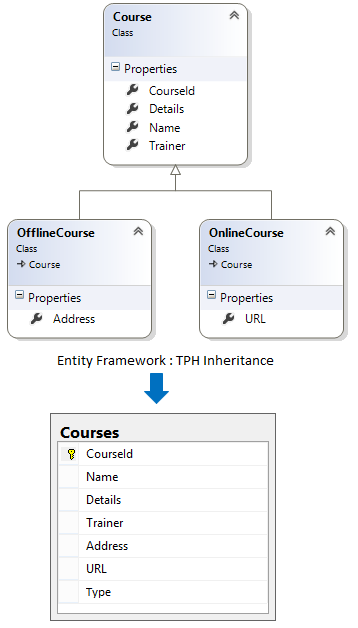
    The TPH inheritance states that all entities, in a hierarchy of entities, are mapped to a single table in storage schema. It means, there is only one table in database and different Entity types in Entity model that inherits from a base Entity are mapped to that table.

    Table-per-Hierarchy (TPH)

    C# Implementation Code for TPH

     public class Course
     {
     [Key]
     public int CourseId { get; set; }
     public string Name { get; set; }
     public string Details { get; set; }
     public string Trainer { get; set; }
     }
    
     public class OnlineCourse : Course
     {
     public string URL { get; set; }
     }
    
     public class OfflineCourse : Course
     {
     public string Address { get; set; }
     }
    

    Entity Framework Code First Mapping for TPH

    modelBuilder.Entity<Course>()
     .Map<OnlineCourse >(m => m.Requires("Type").HasValue("OnlineCourse "))
     .Map<OfflineCourse >(m => m.Requires("Type").HasValue("OfflineCourse "));
    

    Note

    By default, Entity Framework supports TPH inheritance, if you don't define any mapping details for your inheritance hierarchy.

  2. Table-per-Concrete-Type (TPC)

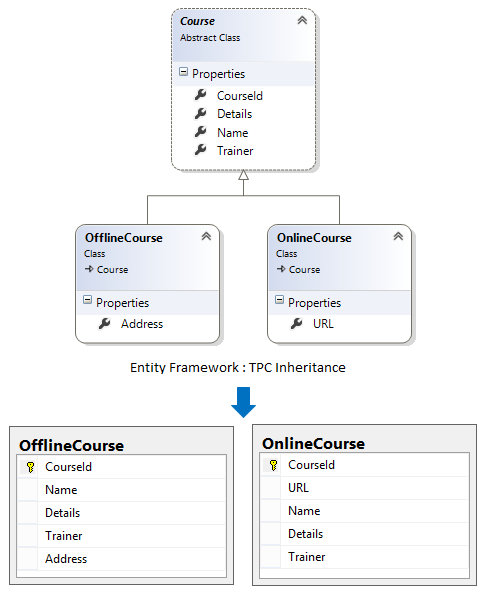
    The TPC inheritance states that each concrete class (a class which can be instantiated) in the hierarchy of entities is mapped to a separate table in storage schema. It means, there is separate table in database to maintain data for each derived entity type.

    Table-per-Concrete-Type (TPC)

    C# Implementation Code for TPC

     public abstract class Course //abstract class
     {
     [Key]
     public int CourseId { get; set; }
     public string Name { get; set; }
     public string Details { get; set; }
     public string Trainer { get; set; }
     }
    
     public class OnlineCourse : Course //concrete class
     {
     public string URL { get; set; }
     }
    
     public class OfflineCourse : Course //concrete class
     {
     public string Address { get; set; }
     }
    

    Entity Framework Code First Mapping for TPC

    modelBuilder.Entity<OnlineCourse >().Map(m =>
    {
     m.MapInheritedProperties();
     m.ToTable("OnlineCourse ");
    });
    
    modelBuilder.Entity<OfflineCourse >().Map(m =>
    {
     m.MapInheritedProperties();
     m.ToTable("OfflineCourse ");
    });
    

    Note

    The TPC inheritance is commonly used to inherit basic features.

  3. Table-per-Type (TPT)

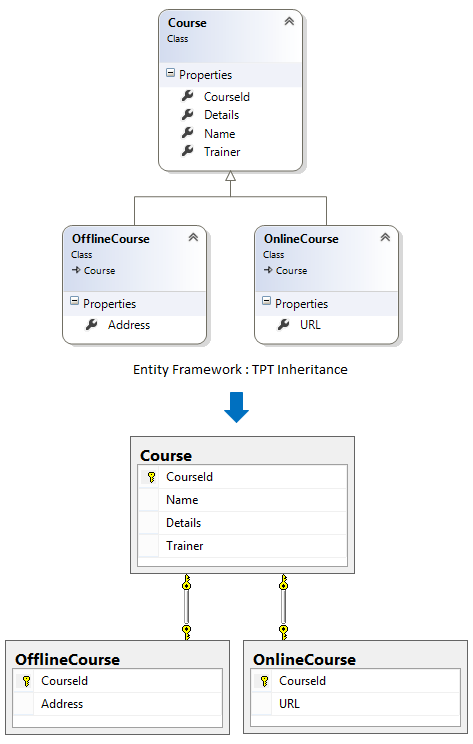
    The TPT inheritance states that each entity in the hierarchy of entities is mapped to a separate table in storage schema. It means, there is separate table in database to maintain data for each Entity Type.

    Table-per-Type (TPT)

    C# Implementation Code for TPT

     public class Course
     {
     [Key]
     public int CourseId { get; set; }
     public string Name { get; set; }
     public string Details { get; set; }
     public string Trainer { get; set; }
     }
    
     public class OnlineCourse : Course
     {
     public string URL { get; set; }
     }
    
     public class OfflineCourse : Course
     {
     public string Address { get; set; }
     }
    

    Entity Framework Code First Mapping for TPT

    modelBuilder.Entity<Course>().ToTable("Course");
    modelBuilder.Entity<OnlineCourse >().ToTable("OnlineCourse ");
    modelBuilder.Entity<OfflineCourse >().ToTable("OfflineCourse ");
    

    Note

    TPH inheritance patterns generally deliver better performance in the Entity Framework than TPT inheritance patterns, because TPT patterns can result in complex join queries.

Share:

OOPS

 Object-Oriented Programming (OOP) is a programming paradigm based on the concept of "objects," which are instances of classes. OOP principles make code more modular, reusable, and easier to understand and maintain. Let’s use a phone as an example to explain the four main OOP principles:

1. Encapsulation

  • Definition: Encapsulation is the bundling of data (attributes) and methods (functions) that operate on that data within a single unit, called a class. It also restricts access to certain details of an object’s data and methods.
  • Example: In a Phone class, we may have private attributes like batteryLevel and isOn. To check the battery level or turn the phone on or off, we provide public methods like checkBattery() and powerOn() instead of allowing direct access to the attributes.
  • Explanation: This way, the inner workings of batteryLevel or isOn are hidden from other parts of the program, making it secure and ensuring the data is only modified in a controlled manner.

2. Abstraction

  • Definition: Abstraction involves hiding complex implementation details and showing only the essential features of an object.
  • Example: Think of the Phone class again. The user of a Phone doesn’t need to know how the call is connected or how the message is sent internally. They just use methods like makeCall() or sendMessage().
  • Explanation: Abstraction allows the user to interact with the phone through simple, high-level interfaces, without needing to understand the technical complexity of how these functions work behind the scenes.

3. Inheritance

  • Definition: Inheritance is a mechanism where a new class (child class) derives or inherits properties and behaviors (methods) from an existing class (parent class).
  • Example: Suppose we have a base class Phone. We can create a SmartPhone class that inherits from Phone, adding new features like takePhoto() or browseInternet() while retaining core functions like makeCall() and sendMessage().
  • Explanation: Inheritance allows the SmartPhone class to reuse the code in Phone, promoting code reuse and a hierarchical relationship between classes.

4. Polymorphism

  • Definition: Polymorphism allows objects of different classes to be treated as objects of a common super class. It also allows the same operation to behave differently on different classes.
  • Example: Let’s say both BasicPhone and SmartPhone classes have a makeCall() method. However, the makeCall() in SmartPhone might involve using VoIP (internet calling), while in BasicPhone it uses traditional cellular calling. By calling makeCall() on a Phone object, the correct method is chosen based on the actual type of the phone (either BasicPhone or SmartPhone).
  • Explanation: Polymorphism allows the Phone class to handle different types of phones (smartphones or basic phones) in a uniform way, making the code more flexible and extensible.

Summary of OOP Principles with the Phone Example

  • Encapsulation: Keeps phone attributes private and allows controlled access through public methods.
  • Abstraction: Hides the complexity of functions like makeCall() and sendMessage() from the user.
  • Inheritance: Allows new types of phones to reuse existing functionality from a base Phone class.
  • Polymorphism: Enables different types of phones to define their own versions of a function like makeCall() while being accessed through a common interface.

These OOP principles help create a well-organized, modular, and adaptable phone system.

Share:

Solid Principles

 The SOLID principles are five key design principles in object-oriented programming aimed at making software designs more understandable, flexible, and maintainable. Let's go through each principle with a simple example of a phone system:

1. Single Responsibility Principle (SRP)

  • Definition: A class should have only one reason to change, meaning it should only have one job or responsibility.
  • Example: In a phone application, you might have separate classes for:
    • CallManager for handling calls.
    • ContactManager for managing contacts.
    • MessageManager for managing SMS and chats.
  • Explanation: Each class has a single responsibility, so changes in the contact list won’t affect the call functionality, and vice versa.

2. Open/Closed Principle (OCP)

  • Definition: Software entities should be open for extension but closed for modification.
  • Example: Let’s say you have a Phone class with a method to send messages. Instead of modifying the Phone class to support email or video messages, you create subclasses like TextMessage, EmailMessage, and VideoMessage that extend a Message class.
  • Explanation: This way, the Phone class doesn’t need modification; it only interacts with the base Message type, which can be extended for new message types.

3. Liskov Substitution Principle (LSP)

  • Definition: Objects of a superclass should be replaceable with objects of its subclasses without affecting the functionality.
  • Example: Suppose you have a BasicPhone class with a makeCall() method. Now, you create a SmartPhone subclass that can make calls and send messages. If any part of your program uses BasicPhone, you should be able to replace it with SmartPhone without errors.
  • Explanation: SmartPhone is substitutable for BasicPhone, as it maintains all the expected behavior.

4. Interface Segregation Principle (ISP)

  • Definition: A client should not be forced to implement interfaces it doesn’t use.
  • Example: If you create an interface SmartDevice with methods like makeCall(), takePhoto(), and browseInternet(), a simple feature phone might not need takePhoto() or browseInternet(). Instead, break it down into smaller interfaces, like Callable, CameraCapable, and InternetCapable.
  • Explanation: A basic phone can implement only Callable, while a smartphone might implement all three. This keeps each phone class focused on only the features it supports.

5. Dependency Inversion Principle (DIP)

  • Definition: High-level modules should not depend on low-level modules but on abstractions.
  • Example: Imagine your phone app needs to send a message. Instead of directly calling a SMSService or EmailService class, the Phone class depends on an abstract MessageService interface. Then, you can implement different types of MessageService for SMS, email, or even social media messages.
  • Explanation: The Phone class doesn’t care about the specific message type or service; it just uses the MessageService abstraction, making it easy to switch or add new message types.

By following the SOLID principles, you can design a flexible, maintainable, and scalable phone system.

Share:

Sunday, 3 November 2024

Top 100 Interview Question in Anuglar

 Here’s a list of 50 important Angular interview questions and answers covering a variety of topics, including fundamentals, advanced concepts, performance optimization, and best practices.

1. What is Angular?

Answer: Angular is a platform and framework for building client-side applications using HTML, CSS, and TypeScript. It provides a structure for developing dynamic web applications and offers features like two-way data binding, dependency injection, and component-based architecture.

2. What are Components in Angular?

Answer: Components are the building blocks of an Angular application. Each component encapsulates the HTML template, CSS styles, and the logic defined in a TypeScript class. They can be reused throughout the application.

3. What is a Module in Angular?

Answer: A module in Angular is a container that groups related components, directives, pipes, and services. The root module is AppModule, and additional modules can be created to organize the application into cohesive blocks.

4. Explain the concept of Dependency Injection (DI) in Angular.

Answer: Dependency Injection is a design pattern used to implement IoC (Inversion of Control), allowing classes to receive their dependencies from an external source rather than creating them directly. Angular uses DI to provide services and other dependencies to components and other services.

5. What is the purpose of Angular Services?

Answer: Services in Angular are singleton objects that contain business logic or reusable functionality. They are used to share data and functionality across components and provide a way to organize code.

6. What is the difference between ngIf and ngSwitch?

Answer: ngIf is used to conditionally include or exclude a template based on a boolean expression, whereas ngSwitch allows for multiple conditional templates to be rendered based on a specific expression's value.

7. What are Directives in Angular?

Answer: Directives are classes that add behavior to elements in Angular applications. There are three types of directives: components (which are directives with a template), structural directives (e.g., ngIf, ngFor), and attribute directives (e.g., ngClass).

8. What is Two-Way Data Binding?

Answer: Two-way data binding is a synchronization mechanism between the model and the view. Changes in the model are reflected in the view and vice versa. This is typically achieved using [(ngModel)].

9. What are Pipes in Angular?

Answer: Pipes are used to transform data in templates. They can format dates, currencies, and other data types. Custom pipes can also be created to implement specific data transformations.

10. What is Routing in Angular?

Answer: Routing in Angular allows navigation between different views or components in the application. It enables users to move between pages without refreshing the browser, improving the user experience.

11. How do you create a Service in Angular?

Answer: To create a service in Angular, use the Angular CLI command ng generate service serviceName. This creates a service class with a default method.

12. Explain the difference between Observable and Promise.

Answer: An Observable is a stream of data that can emit multiple values over time, while a Promise is a single value that may be available now or in the future. Observables are more powerful and can be canceled, while promises cannot.

13. What are Lifecycle Hooks in Angular?

Answer: Lifecycle hooks are methods that Angular calls at specific points in a component or directive's lifecycle, such as ngOnInit, ngOnChanges, ngOnDestroy, etc. They allow developers to hook into the lifecycle of a component.

14. How do you handle events in Angular?

Answer: Events in Angular are handled using event binding. This is done by enclosing the event name in parentheses and assigning it to a method in the component. For example: <button (click)="onClick()">Click Me</button>.

15. What is Angular Universal?

Answer: Angular Universal is a technology that enables server-side rendering (SSR) of Angular applications. It helps improve SEO, initial loading performance, and can generate static HTML pages.

16. Explain the concept of Reactive Forms.

Answer: Reactive Forms are a way to build forms in Angular using reactive programming principles. They provide more control over form behavior and validation, using FormGroup, FormControl, and observables.

17. What is Template-Driven Forms?

Answer: Template-Driven Forms are a way to create forms in Angular using Angular directives in the template. They are simpler but provide less control compared to reactive forms.

18. What is the purpose of ngZone in Angular?

Answer: ngZone is a service that helps Angular manage change detection. It allows Angular to know when to run change detection, which can optimize performance by minimizing unnecessary checks.

19. What are Guards in Angular?

Answer: Guards are used to control access to routes in an Angular application. They can prevent navigation based on conditions, such as authentication status. Common types of guards include CanActivate, CanDeactivate, Resolve, and CanLoad.

20. What is a Subject in RxJS?

Answer: A Subject is a special type of Observable that allows multicasting to multiple subscribers. It can be used to emit values to subscribers at any time, unlike regular observables that emit values over time.

21. Explain Lazy Loading in Angular.

Answer: Lazy loading is a technique that allows the application to load modules only when they are needed rather than loading all modules at once. This helps improve the initial load time and overall performance of the application.

22. What is the purpose of async pipe?

Answer: The async pipe is used to subscribe to an observable or promise in the template and automatically unsubscribe when the component is destroyed. It simplifies handling asynchronous data in templates.

23. What are the benefits of using Angular CLI?

Answer: Angular CLI provides a powerful command-line interface to automate tasks such as project setup, scaffolding, testing, and deployment. It follows best practices and helps improve developer productivity.

24. How do you manage application state in Angular?

Answer: Application state can be managed using services, RxJS, and state management libraries like NgRx or Akita. Services can provide a centralized way to manage shared data across components.

25. What is a Custom Pipe in Angular?

Answer: A custom pipe is a user-defined transformation function that can be used in templates. It allows developers to create specific data transformations tailored to their application's needs.

26. How do you implement error handling in Angular?

Answer: Error handling can be implemented using services that intercept HTTP requests and responses, using the HttpInterceptor class. Additionally, global error handling can be done using Angular's error handling strategies.

27. What is the difference between ngFor and ngIf?

Answer: ngFor is used to iterate over a collection and render a template for each item, while ngIf conditionally includes or excludes a template based on a boolean expression.

28. Explain the concept of @Input() and @Output().

Answer: @Input() is a decorator that allows data to be passed from a parent component to a child component. @Output() is used to emit events from the child component to the parent component.

29. What is AOT Compilation?

Answer: Ahead-of-Time (AOT) compilation is a feature that compiles Angular templates into JavaScript code during the build process, resulting in faster rendering and smaller bundle sizes.

30. What is JIT Compilation?

Answer: Just-in-Time (JIT) compilation compiles the Angular application in the browser at runtime. This results in a longer initial load time compared to AOT but allows for more flexible development.

31. What are Observables in Angular?

Answer: Observables are a core part of RxJS and provide a way to work with asynchronous data streams. They allow subscribing to data changes and handling multiple values over time.

32. What is ng-content used for?

Answer: ng-content is used in Angular to project content into a component from the parent component's template, enabling content distribution and creating reusable components.

33. How do you implement internationalization (i18n) in Angular?

Answer: Angular provides built-in support for internationalization (i18n) through the @angular/localize package. Developers can use translation files to manage different languages and display text accordingly.

34. What is the purpose of trackBy in ngFor?

Answer: The trackBy function is used to improve the performance of ngFor by tracking items in a list based on a unique identifier. This helps Angular efficiently update the DOM when items change.

35. How do you create a dynamic form in Angular?

Answer: A dynamic form can be created by using reactive forms and FormGroup/ FormArray to programmatically add or remove form controls based on user input or other criteria.

36. Explain how to use ngModel in Angular forms.

Answer: ngModel is a directive used in template-driven forms to bind the form control's value to a component property. It enables two-way data binding for form inputs.

37. What is the purpose of FormGroup and FormControl?

Answer: FormGroup is a class that groups together related form controls, while FormControl represents a single input field in a form. Together, they enable building complex forms with validation.

38. What is Change Detection in Angular?

Answer: Change Detection is a mechanism that Angular uses to check for changes in component properties and update the view accordingly. Angular uses a tree of components to detect changes and re-render only affected components.

39. How do you optimize performance in Angular applications?

Answer: Performance can be optimized by using lazy loading, change detection strategies (OnPush), trackBy with ngFor, optimizing HTTP requests, minimizing bundle size with AOT, and using memoization techniques.

40. What are the different ways to communicate between components?

Answer: Components can communicate via:

  • Input and Output properties (@Input() and @Output())
  • Shared services
  • Event emitters
  • Router parameters and query parameters

41. How do you set up a global error handler in Angular?

Answer: A global error handler can be set up by implementing the ErrorHandler class and overriding the handleError method. This class can be registered in the providers array of an Angular module.

42. Explain the concept of a Factory Provider in Angular.

Answer: A Factory Provider allows developers to provide dependencies based on a function that returns the desired value or object. This provides flexibility in configuring how dependencies are created.

43. What is the difference between Promise.all() and forkJoin in RxJS?

Answer: Promise.all() waits for all promises to resolve and returns a single promise with the results, while forkJoin waits for all observables to complete and returns an observable with the last emitted values from each observable.

44. What are structural directives in Angular?

Answer: Structural directives change the DOM layout by adding or removing elements based on a condition. Examples include ngIf, ngFor, and ngSwitch.

45. How do you handle HTTP requests in Angular?

Answer: HTTP requests are handled using the HttpClient module, which provides methods for making GET, POST, PUT, DELETE requests and handling responses, error handling, and interceptors.

46. What is the purpose of async and await in Angular?

Answer: async and await are used to simplify working with promises, making asynchronous code look synchronous. They improve code readability and help manage asynchronous operations effectively.

47. How do you implement role-based access control (RBAC) in Angular?

Answer: RBAC can be implemented using route guards that check the user's role before allowing access to specific routes. The user's role can be obtained from a user service or authentication service.

48. What is the ng-template directive?

Answer: ng-template is a directive used to define a template that is not rendered by default. It can be used with structural directives to create reusable templates.

49. Explain how to use Angular Material in an Angular application.

Answer: Angular Material is a UI component library that provides pre-built components following Material Design principles. It can be integrated by installing the Angular Material package, importing Material modules, and using the components in templates.

50. What is the purpose of ViewChild and ContentChild?

Answer: ViewChild is used to access a child component or directive within a template, while ContentChild is used to access a child component projected into the template using ng-content. They enable interaction with child components programmatically.

These questions cover a range of topics that are crucial for Angular development and can help prepare for interviews or deepen your understanding of Angular concepts.


Here’s an additional list of 50 important Angular interview questions and answers, providing deeper insights into various aspects of the framework.

51. What are Angular Decorators?

Answer: Decorators are special types of declarations that attach metadata to classes and their members. They are used to configure components, directives, modules, and services, such as @Component(), @Injectable(), and @NgModule().

52. How do you implement Guards in Angular Routing?

Answer: Guards can be implemented by creating a service that implements one of the guard interfaces (like CanActivate) and then registering it in the routing module to protect specific routes based on conditions.

53. Explain the concept of Change Detection Strategy in Angular.

Answer: Change Detection Strategy determines how Angular checks for changes in a component. The default strategy checks the entire component tree, while the OnPush strategy checks only when the input properties change by reference, an event occurs, or an observable emits a new value.

54. What is the ngZone service used for in Angular?

Answer: The ngZone service is used to manage Angular's change detection mechanism. It provides a way to execute code outside of Angular's zone to improve performance by limiting the number of change detection cycles.

55. What is the purpose of ng-container?

Answer: ng-container is a structural directive that acts as a placeholder in the template without adding any extra DOM elements. It is useful for grouping directives and avoiding additional wrapping elements in the DOM.

56. How do you handle user input validation in Angular Forms?

Answer: User input validation can be handled using built-in validators or custom validators in reactive forms. For template-driven forms, Angular provides directives like ngModel to automatically manage validation.

57. What is the role of the ng-template directive?

Answer: The ng-template directive is used to define a template that can be instantiated later. It does not render anything in the DOM until it is specifically called or used by directives such as *ngIf or *ngFor.

58. Explain how to create a custom directive in Angular.

Answer: A custom directive can be created by using the Angular CLI command ng generate directive directiveName. The directive class must be decorated with @Directive() and can have a selector and behavior defined in the class.

59. What is the purpose of ViewEncapsulation in Angular?

Answer: ViewEncapsulation determines how styles defined in a component affect the rest of the application. The options are:

  • Emulated (default): Styles are scoped to the component.
  • None: Styles apply globally.
  • ShadowDom: Uses the native Shadow DOM for style encapsulation.

60. How do you implement a service worker in Angular?

Answer: A service worker can be implemented by using the Angular Service Worker package. This involves running ng add @angular/pwa, which configures the project to support service workers for caching and offline capabilities.

61. What is the purpose of async pipe in Angular templates?

Answer: The async pipe is used to subscribe to an Observable or Promise in templates. It automatically manages the subscription and handles the emitted values, making it easier to work with asynchronous data.

62. What is the difference between ngIf and ngIfElse?

Answer: ngIf conditionally renders a template based on a boolean expression, while ngIfElse allows you to specify an alternative template to render if the condition is false, providing a cleaner way to handle conditional rendering.

63. Explain the concept of "zone" in Angular.

Answer: Zones are execution contexts that Angular uses to track asynchronous operations such as promises, setTimeout, and events. They allow Angular to know when to trigger change detection automatically.

64. What is the role of resolve in Angular routing?

Answer: The resolve property in route configuration allows you to fetch data before navigating to a route. A resolver service is defined that preloads the required data, ensuring that the data is available when the component is loaded.

65. How do you implement Pagination in Angular?

Answer: Pagination can be implemented by managing a subset of data to display at a time and using components like ngx-pagination or by creating custom pagination logic to control the displayed data based on the current page.

66. What is the purpose of ngForTrackBy?

Answer: The trackBy function used in ngFor helps optimize performance by providing a unique identifier for each item in the list. This allows Angular to efficiently track and update only the changed items, reducing re-renders.

67. Explain the differences between @Component and @Directive.

Answer: @Component is a decorator that defines a component with its own template and styles, whereas @Directive is used to create directives that enhance or modify the behavior of existing elements without defining a template.

68. How do you access the HttpClient in Angular?

Answer: The HttpClient can be accessed by importing it from @angular/common/http and injecting it into a service or component constructor. This enables you to make HTTP requests to external APIs.

69. What is the purpose of ngClass in Angular?

Answer: ngClass is a directive that allows you to dynamically assign CSS classes to an element based on conditions. It can accept a string, array, or object to control the application of classes.

70. What is the purpose of the ChangeDetectorRef service?

Answer: The ChangeDetectorRef service provides methods to manually trigger change detection and control the behavior of the change detection strategy. It can be used for optimizing performance in complex scenarios.

71. How do you implement feature modules in Angular?

Answer: Feature modules are created using the Angular CLI (ng generate module moduleName) and can encapsulate components, services, and routes related to a specific feature, promoting modular architecture and lazy loading.

72. What are interceptors in Angular?

Answer: Interceptors are services that can modify HTTP requests and responses globally. They are useful for adding authentication tokens, logging requests, handling errors, or modifying headers before sending requests.

73. How do you implement HTTP Interceptors?

Answer: To implement HTTP interceptors, create a service that implements HttpInterceptor and its intercept method. Register the interceptor in the providers array of the AppModule.

74. What is the FormBuilder service?

Answer: The FormBuilder service is a helper service that provides methods to create reactive forms more easily. It allows for less verbose syntax when creating FormGroup and FormControl instances.

75. What is the pipe method in RxJS?

Answer: The pipe method in RxJS allows you to compose operators to transform or manipulate the values emitted by an Observable. It takes one or more operators as arguments and returns a new Observable.

76. Explain how you can make an Angular application responsive.

Answer: Responsiveness in an Angular application can be achieved by using CSS frameworks like Bootstrap or Angular Material, employing CSS Grid and Flexbox, and using Angular's media queries to adapt the layout based on screen size.

77. What is the role of ng-content in Angular?

Answer: ng-content is used to create content projection, allowing a component to accept external content and project it into its template. This facilitates building reusable components.

78. What are the different types of pipes in Angular?

Answer: There are two types of pipes in Angular:

  • Pure Pipes: These pipes only execute when the input data changes.
  • Impure Pipes: These pipes execute on every change detection cycle, regardless of whether the input data has changed.

79. How do you use the mat-table component from Angular Material?

Answer: The mat-table component is used to create tables in Angular Material. It requires the MatTableDataSource for data handling, and templates for defining columns and rows, along with pagination and sorting functionalities.

80. Explain the difference between routerLink and href.

Answer: routerLink is an Angular directive that enables navigation within the Angular application without reloading the page. href is a standard HTML attribute that navigates to the specified URL, potentially reloading the page.

81. How do you create a nested route in Angular?

Answer: Nested routes can be created by defining child routes within a parent route in the routing module. This allows components to be rendered within other components based on the current URL.

82. What is the purpose of @HostBinding() and @HostListener()?

Answer: @HostBinding() allows you to bind a property of the host element to a property in the directive or component. @HostListener() allows you to listen to events on the host element and trigger methods in the component or directive.

83. How do you implement custom validators in Angular?

Answer: Custom validators can be created by implementing a function that takes a FormControl and returns an error object if validation fails or null if validation passes. These validators can then be applied to form controls.

84. What is the purpose of ngOnInit lifecycle hook?

Answer: The ngOnInit lifecycle hook is called once the component has been initialized. It is used for any initialization logic, such as fetching data or setting up properties, before the component is rendered.

85. How do you implement a custom observable?

Answer: A custom observable can be created using the Observable constructor. You define the behavior of the observable by providing a function that handles subscriptions, emissions, and completion.

86. What is Service Worker and how is it used in Angular?

Answer: A Service Worker is a script that runs in the background of a web application to enable features like offline support, caching, and background synchronization. In Angular, it can be integrated using the Angular PWA package.

87. How do you use the HttpParams class in Angular?

Answer: The HttpParams class is used to construct query parameters for HTTP requests. You can create an instance of HttpParams, append key-value pairs, and pass it as options in HTTP requests.

88. What are the benefits of using Angular Material?

Answer: Angular Material provides a set of reusable UI components that follow Material Design guidelines, ensuring consistency in design, improving development speed, and offering accessibility features out of the box.

89. How can you prevent memory leaks in Angular?

Answer: Memory leaks can be prevented by unsubscribing from observables, detaching event listeners, and using the takeUntil operator with Subject to complete observables when the component is destroyed.

90. What is the ngAfterViewInit lifecycle hook?

Answer: The ngAfterViewInit lifecycle hook is called after Angular has fully initialized a component's view. It is used to perform actions that require the component's view to be rendered, such as DOM manipulations or initializing third-party libraries.

91. What are Angular Schematics?

Answer: Angular Schematics are templates that automate project setup, code generation, and modification tasks. They can be used to create new components, services, and modules with predefined configurations.

92. Explain how to use Guards for route protection in Angular.

Answer: Guards can protect routes by implementing guard interfaces (e.g., CanActivate) and returning a boolean value or an observable that resolves to true or false based on user permissions.

93. How do you implement a shared service in Angular?

Answer: A shared service can be created by generating a service using Angular CLI and providing it in a module or component. This service can then be injected into multiple components for shared functionality.

94. What is the purpose of ngOnDestroy lifecycle hook?

Answer: The ngOnDestroy lifecycle hook is called just before Angular destroys the component. It is used to clean up resources, unsubscribe from observables, and detach event listeners to prevent memory leaks.

95. Explain the concept of Lazy Loading in Angular.

Answer: Lazy Loading is a technique where modules are loaded on demand rather than at the application startup. This improves performance by reducing the initial bundle size and loading resources only when needed.

96. How do you handle localization in Angular?

Answer: Localization can be handled using Angular's @angular/localize package, allowing developers to translate application content into different languages based on user preferences or browser settings.

97. What is the purpose of ngZone.runOutsideAngular()?

Answer: ngZone.runOutsideAngular() allows developers to run code outside of Angular's zone, preventing unnecessary change detection cycles, which can improve performance in scenarios where Angular does not need to be aware of changes.

98. How do you implement two-way data binding in Angular?

Answer: Two-way data binding can be implemented using the [(ngModel)] directive in template-driven forms or by using FormGroup and FormControl in reactive forms, allowing synchronization between the view and the model.

99. What is the angular.json file?

Answer: The angular.json file is the workspace configuration file for Angular applications. It contains settings for build options, file paths, and project configuration, allowing developers to manage the structure and settings of the application.

100. What is a Singleton Service in Angular?

Answer: A Singleton Service is a service that is instantiated only once throughout the lifetime of the application. It can be provided at the root level, ensuring that the same instance is shared across all components that inject it.

These questions and answers can help deepen your understanding of Angular concepts and prepare for interviews, covering a wide range of topics from basic to advanced features.

Share: